
Choose how you read it: go through the guide online below, or download the PDF (in Polish). Any questions? Call us: +48 609 815 261.
The video is in Polish — the full content is written out in English below.
Contents:
- 1) Is your child ready?
- 2) How to talk to your child
- 3) Why routines matter
- 4) The stages of settling in
- 5) The first days — practical tips
- 6) Working with the preschool
- 7) What next — a calm next step
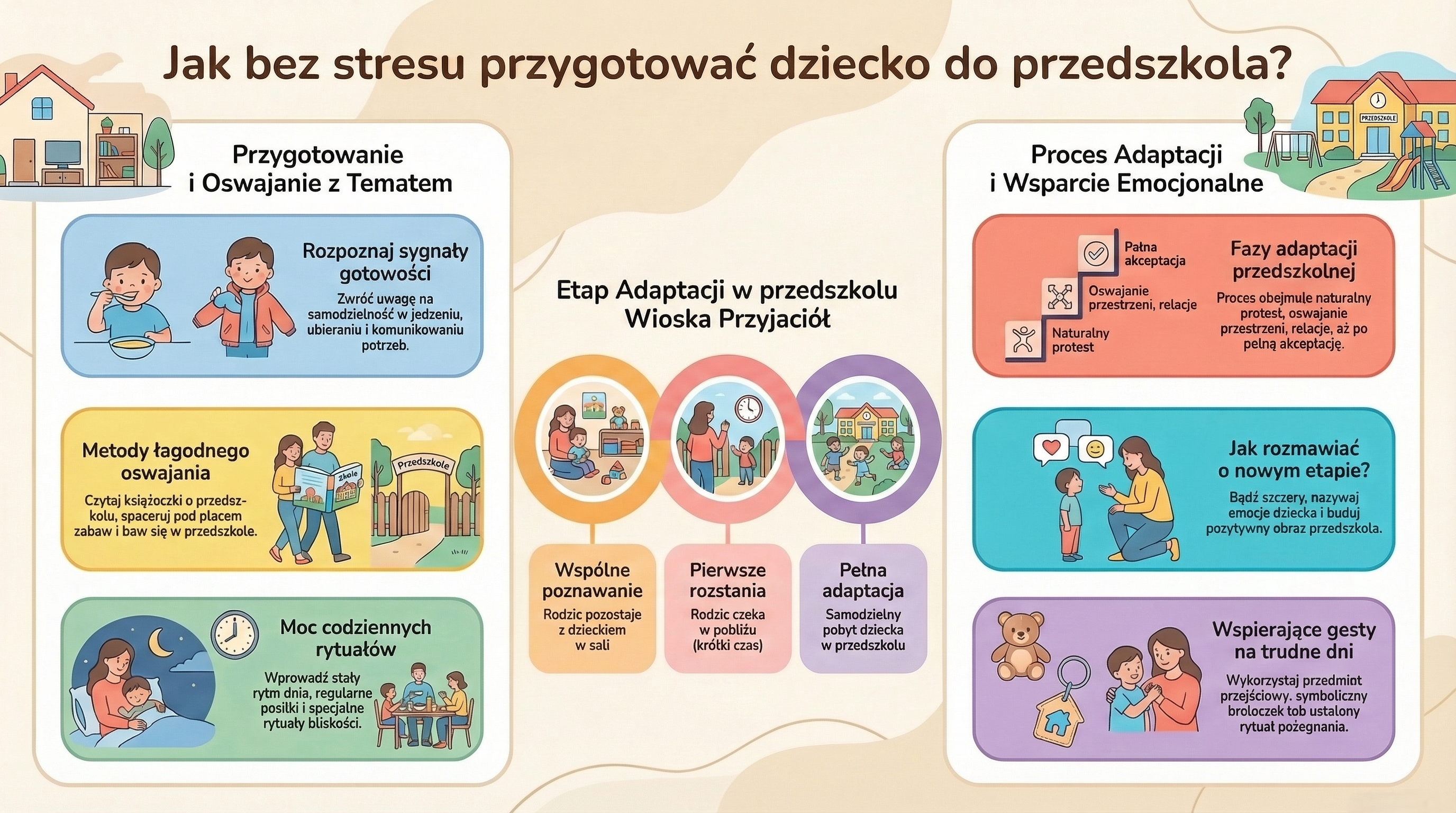
1) Is your child ready — without pressure
Readiness for preschool is not „a test to pass". It is a set of signals that help you judge whether your child has the resources to cope with a new daily rhythm and with separation from a parent. Every child matures at their own pace.
- curiosity about the world and a wish to explore
- accepting a short separation from a carer
- being able to calm down with an adult’s help
- at least partial independence (e.g. eating, dressing)
- crying at drop-off
- regression (e.g. poorer sleep, more need for closeness)
- strong emotions after coming home
- mood swings in the first weeks

The most important thing: your child does not have to be „perfectly ready". What usually matters most is a sense of safety, predictability and a calm adult nearby.
2) How to talk to your child about preschool
Children pick up on their parents’ emotions. Simplicity, calm and repetition work best. Short messages are more effective than long explanations.
- „You will be in a safe place. The teachers will help you."
- „I will come for you after lunch / after the afternoon snack."
- „You can cry. That is normal. I am here."
- „You will see the room, the toys, and meet the other children."
- threats („if you are not good…")
- promises you cannot keep („you will not miss me at all")
- drawing goodbyes out
- slipping away without a word (this increases anxiety)

A small technique: prepare two or three „fixed" sentences and repeat them every day (children like predictability). For example: „Now preschool, then lunch, and then we go home".
3) Why daily routines matter
Routines give a child a sense of control and safety. They do not have to be „perfect" — what matters is that they are consistent and short.
Keep mealtimes regular. Keep bedtimes consistent. Plan time for play and for rest.
Wake your child gently. Make breakfast together. „Talk the day through" while getting dressed.
Create a special hello and goodbye. You might invent a „secret handshake" or an „I love you" phrase.
Read a bedtime story. Hug and kiss goodnight. Sing a lullaby.
A tip: the goodbye routine at preschool should be short (20–40 seconds). Drawing it out usually intensifies emotions.
4) The stages of settling in
Settling in usually comes in waves. Some children move through it quickly, others more slowly. The emotions are natural and important — they do not need to be „switched off", only calmly worked through.
A natural reaction to separation from a parent. A child may test boundaries and look for a sense of safety.
Discovering the room, the toys and the rhythm of the day. The child begins to understand „what happens here".
First friendships, trust in the teachers, more ease within the group.
The child feels safe and knows that preschool is „their place".
Remember: settling in is an individual process. Do not compare your child with others. The biggest turning point usually comes when a child senses predictability and calm in the adults around them.
5) The first days — practical tips
Simplicity wins here: have a plan, shorten the mornings, look after sleep and food, and keep a consistent goodbye routine at preschool. These „small things" make a big difference.
- lay out clothes and the preschool bag
- talk briefly and calmly about the plan for the day
- make sure your child goes to bed earlier
- leave extra time (no rushing)
- short, consistent messages („now preschool, then I come back")
- a short goodbye, without drawing it out
After coming home: some children „hold it together" at preschool and let the emotions out at home. That is normal. Closeness, quiet play and not being interrogated all help.
6) Working with the preschool
The best results come from working together and being consistent: parents and preschool pulling in the same direction. If your child has a harder start, it is worth sharing observations and adjusting the approach to their needs.
- what your child enjoys (games, interests)
- what calms them (a hug, a routine, a favourite song)
- what they are afraid of and how they react to stress
- important matters (sleep, diet, health)
- a predictable daily rhythm
- a consistent goodbye routine
- trust in their carers
- calm and consistency from the adults
The most important thing: settling in is something children get through. It is not „one difficult moment" but a process. Once a child begins to feel safe, curiosity appears — and then the joy of being part of the group.
7) What next — a calm next step
If, after reading this, you would like to know what your child’s start could look like at our preschool, get in touch or go to the admissions information.
If you are still comparing preschools, you may also find our list of questions worth asking before choosing a preschool useful.
Talk to our psychologist or special-needs teacher — with no obligation.